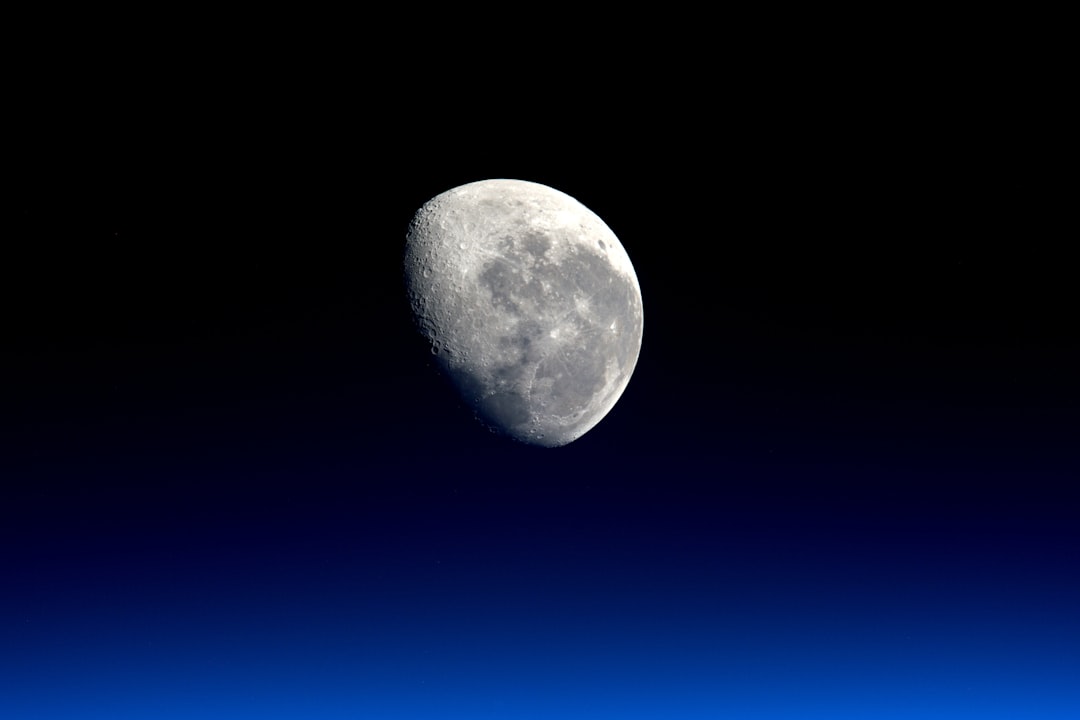
A spent Falcon 9 upper stage is expected to strike the lunar surface, offering researchers a rare opportunity to observe and measure a controlled impact event.
A spent upper stage of a SpaceX Falcon 9 rocket was expected to collide with the Moon on Friday, creating what scientists anticipate will be a measurable impact crater. The unintended collision presents researchers with a valuable opportunity to gather real-time data on lunar impacts—a phenomenon difficult to study through conventional observation methods. The event marks one of the few instances when a large piece of space debris has been tracked to deliberately strike the lunar surface under monitored conditions.
The Falcon 9 upper stage, which had completed its primary mission carrying cargo to orbit, was left on a trajectory that calculations showed would eventually intersect with the Moon's path. Rather than remaining in Earth orbit indefinitely, where it could pose a collision hazard to operational satellites, the stage's trajectory naturally decayed over time, bringing it into the Moon's gravitational sphere. Scientists had been monitoring the object's trajectory for months, refining impact predictions as new data became available.
What the impact might reveal
Lunar impacts, whether from natural meteorites or human-made debris, leave behind distinctive crater formations that scientists use to understand the Moon's geology and composition. The Falcon 9 stage collision offers a rare chance to observe a known-mass object striking at a calculated velocity, generating impact data that can be correlated with observations from lunar orbiters and ground-based telescopes. This type of controlled impact study has historically been difficult to conduct, making the event scientifically valuable.
The crater's size and characteristics will depend on several factors, including the exact velocity at which the rocket stage strikes the surface, the angle of impact, and the composition of the lunar regolith at the impact site. Most predictions suggested the collision would create a crater ranging from 10 to 20 metres in diameter, though precise measurements would require analysis of high-resolution images captured by lunar reconnaissance orbiters. The impact would also generate a plume of lunar dust and ejecta, potentially visible from Earth-based telescopes under favourable conditions.
Researchers planned to use data from NASA's Lunar Reconnaissance Orbiter (LRO) and other spacecraft to document the impact site before and after the collision. Comparing pre- and post-impact imagery would allow scientists to measure crater dimensions, study the distribution of ejected material, and analyse the subsurface composition revealed by the impact. Such observations contribute to the broader understanding of lunar geology and planetary impact mechanics, knowledge applicable to asteroid deflection strategies and planetary defence initiatives.
Historical context and space debris concerns
The unintended lunar impact is not without precedent in the space age. In 2009, NASA deliberately crashed the LCROSS (Lunar Crater Observation and Sensing Satellite) spacecraft into the Moon's south polar region to study subsurface water ice—a mission that provided crucial data about lunar volatiles. However, most instances of space hardware reaching the Moon have been accidental or incidental, rather than part of formal scientific missions. The Falcon 9 stage represents a growing concern within the space industry regarding long-term orbital debris management.
As commercial spaceflight activity has expanded dramatically over the past decade, questions about the disposal of spent rocket stages have become increasingly pressing. Unlike lower Earth orbit, where atmospheric drag eventually causes objects to re-enter and burn up, objects placed on trajectories toward the Moon or beyond may remain in space indefinitely unless actively managed. The Falcon 9 stage's eventual lunar impact highlights the importance of trajectory planning and disposal protocols for future missions, particularly as SpaceX and other companies conduct hundreds of launches annually.
The space industry has begun implementing guidelines and best practices for end-of-life satellite and rocket stage management. These include preferential deorbiting to Earth (where controlled re-entry can be planned), transfer to graveyard orbits far from active spacecraft, or, in some cases, acceptance of eventual lunar or solar system impacts. The Falcon 9 stage collision underscores why such protocols matter—uncontrolled impacts, while scientifically interesting, represent a loss of resources and contribute to the broader problem of orbital debris accumulation.
Scientific instruments positioned to observe
Multiple observatories and spacecraft were positioned to capture data from the impact event. NASA's LRO, which has maintained a nearly continuous presence in lunar orbit since 2009, was tasked with imaging the impact site. The spacecraft's high-resolution camera system has previously documented the locations of lunar impact sites, providing baseline data for comparison. Additionally, ground-based observatories equipped with high-powered telescopes attempted to detect the impact flash—a brief, bright emission caused by the collision's energy release and the heating of surface material.
The Indian Space Research Organisation's Chandrayaan-2 orbiter, which has been studying lunar geology and mineralogy, was also expected to contribute observations. European and Japanese lunar orbiters similarly have instruments capable of detecting impact signatures. The international coordination of observation efforts reflects the scientific value placed on such events, with researchers from multiple space agencies and institutions contributing data and analysis. This collaborative approach maximises the amount of usable information extracted from a single impact event.
Scientists acknowledged that predicting the exact moment and location of impact involved significant uncertainty, particularly as the object approached the Moon. Slight variations in initial trajectory, solar radiation pressure on the rocket stage, and gravitational perturbations from celestial bodies could shift the impact point by several kilometres. Consequently, observatories maintained readiness across a broader geographic area of the lunar surface, and some instruments operated in continuous monitoring mode to capture the event when it occurred.
Broader implications for space exploration
The Falcon 9 stage impact contributes to an emerging body of knowledge about how human spaceflight activity shapes the space environment. As commercial launch rates accelerate and more nations pursue lunar exploration, understanding the consequences of hardware reaching the Moon becomes increasingly important. The crater created by this impact will eventually become part of the lunar geological record, a tangible mark of twenty-first-century space activity alongside the remains of Apollo missions and unmanned probes from decades past.
For SpaceX specifically, the incident prompted reflection on trajectory planning and orbital mechanics. While the collision was not the result of a mission failure, it highlighted the challenges of managing the end-of-life phase of rocket stages launched at high cadence. The company's ambitious expansion of launch operations—supporting satellite internet constellations, cargo missions, and eventual crewed flights—means that trajectory management and debris mitigation will remain ongoing operational concerns.
The event also underscores the Moon's continued relevance as a destination for scientific study and eventual human settlement. As space agencies plan lunar bases and mining operations, understanding lunar geology and surface processes becomes more critical. Impact studies, whether from intentional missions or incidental collisions, provide data that informs site selection, construction planning, and resource assessment. In this sense, the unplanned Falcon 9 stage impact contributes valuable information to the broader project of understanding and eventually inhabiting the lunar environment.
The collision also serves as a reminder of the dynamic nature of cislunar space—the region between Earth and Moon. Once viewed as remote and pristine, this region is increasingly traversed by spacecraft, satellites, and debris. Managing this growing traffic safely and sustainably will require continued international cooperation, improved tracking systems, and adherence to best practices in orbital mechanics and spacecraft disposal. The Falcon 9 impact, while scientifically interesting, represents a challenge that the space community will face with increasing frequency in coming years.